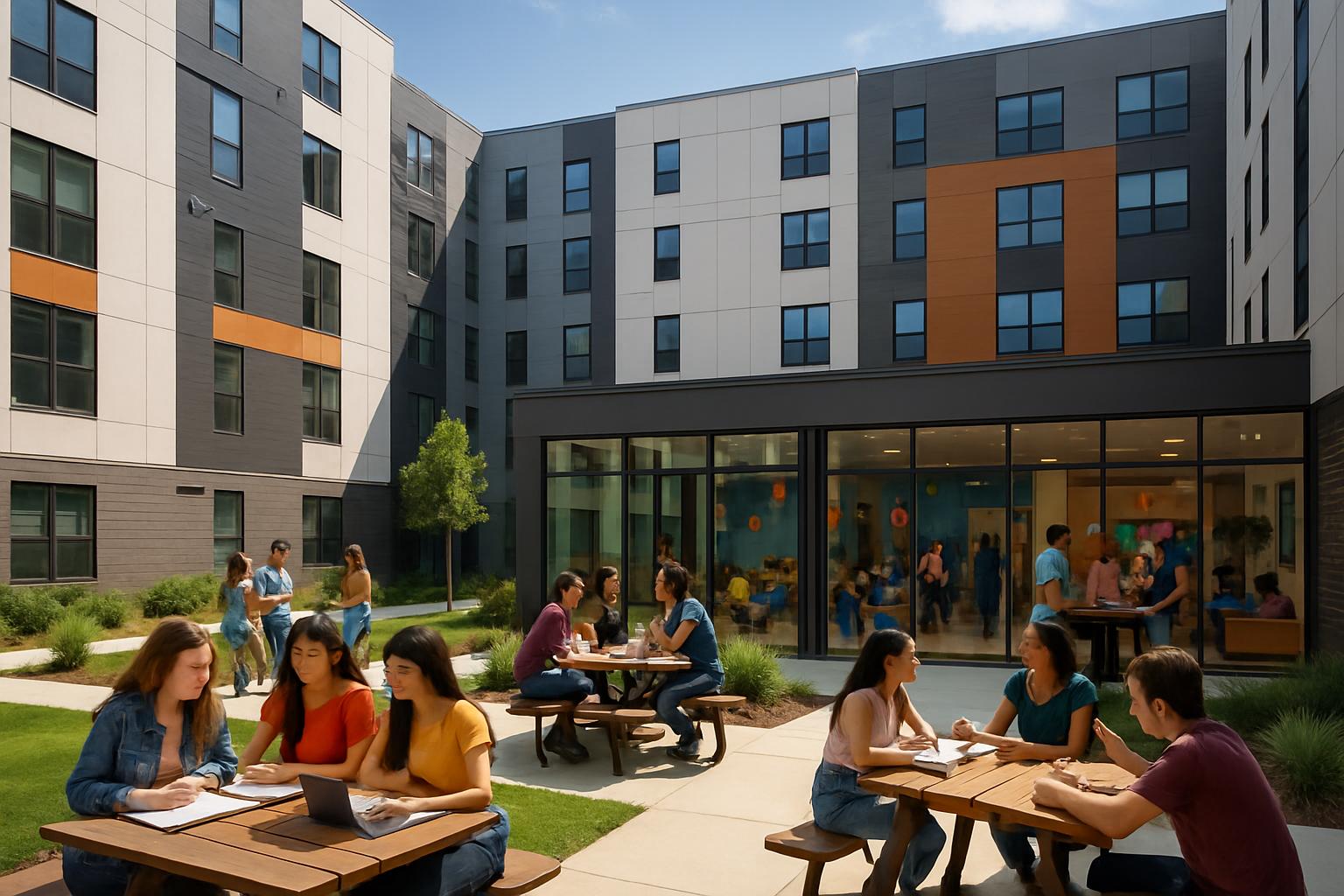
DSCR for Student Housing: High Risks, Higher Rewards
Reviewed by Lisa Park, Compliance & Operations Director
The Investment Case Most Lenders Won't Tell You About
Walk past any major state university on the first weekend of September and you'll see the same scene: U-Hauls double-parked, parents carrying futons, and landlords collecting first month's rent checks with a quiet smile. Student housing is one of the few asset classes in real estate where demand resets itself every single year — and where a four-bedroom house can out-earn a comparable single-family rental by 50% or more on a per-square-foot basis.
But here's what that same landlord won't post on Instagram: the security deposit he collected last year barely covered the carpet replacement, two of his tenants left for the summer with zero notice, and he spent three weekends in August repainting before the new class arrived.
Student housing as a DSCR loan-financed investment is a genuine opportunity — and a genuine minefield. This guide walks you through both sides of the ledger so you can make a clear-eyed decision about whether student rental financing belongs in your portfolio strategy.
What Makes Student Housing Different as an Investment
Student housing occupies its own micro-niche in residential real estate. Unlike a standard single-family rental where you're underwriting one tenant and one income stream, student housing typically means:
- Multiple co-tenants sharing a lease (usually signed jointly or separately by bedroom)
- Parental guarantors who co-sign leases, dramatically reducing default risk
- Annual turnover baked into the lease cycle, tied to the academic calendar
- Per-bedroom pricing rather than whole-house pricing, which compresses the market's ability to push back on rent increases
That last point is the structural advantage. When you rent a four-bedroom house to a family, you get one rent check. When you rent the same house to four students — each paying $700/month — you're effectively running four income streams under one roof. The property hasn't changed. The income has.
The Upside: Why Investors Target Student Housing
Higher Per-Bedroom Rents
The per-bedroom premium near established universities is real and persistent. A comparable four-bedroom house renting as a standard single-family unit in many secondary markets might fetch $1,800/month. The same house configured for student occupancy — with individual leases, furnished common areas, and proximity to campus — can command $650 to $800 per bedroom, putting total monthly revenue at $2,600 to $3,200/month.
That's not a rounding error. That's a 40–78% revenue lift from the same asset.
Demand That Doesn't Depend on the Job Market
Student enrollment at established four-year universities is remarkably stable. Economic downturns often increase college enrollment as workers return to school. Unlike workforce housing tied to employer health or short-term rentals tied to travel trends, student housing demand is anchored to institutional enrollment cycles that span decades.
Parental Guarantors Reduce Default Risk
Most student housing leases near major universities require a parental or guardian co-signer. This is a legitimate underwriting advantage — you're not actually relying on a 20-year-old's income to backstop your rental. You're relying on their parents'. Default rates in professionally managed student housing with parental guarantors are historically low.
Annual Lease Renewals Create Pricing Discipline
Because leases reset every August (or May, depending on the market), you're never locked into a below-market rent for more than one year. Every lease cycle is an opportunity to reprice. In markets with strong university enrollment growth, this annual reset mechanism compounds returns faster than standard residential leasing.
The Downside: What Makes Student Housing Hard
Let's be direct about the challenges, because underestimating them is how investors lose money.
Turnover Costs Are Not Optional
When students move out, they move out completely — and they frequently leave damage behind. Budget $1,500 to $3,000 per turnover for cleaning, minor repairs, repainting, and carpet cleaning. In a four-bedroom student house, you may face partial or full turnover every August. That's a recurring capital cost that eats into your DSCR margins if you don't model it correctly.
Summer Vacancy Is Structural, Not Accidental
Unless you're in a market with strong summer programs or graduate student demand, expect 60–90 days of reduced occupancy between May and August. Some investors require 12-month leases regardless; others offer summer sublet arrangements. Neither eliminates the risk entirely. When you calculate annual income for DSCR purposes, you need to decide whether to use full-year rent or a vacancy-adjusted figure — and lenders will form their own opinion about which one is appropriate.
Property Damage Is Higher Than Single-Family Average
There's no diplomatic way to say this: students are harder on properties than most other tenant categories. Not all students, and not always — but statistically, wear and tear is accelerated in student housing. HVAC filters, kitchen appliances, bathroom fixtures, and flooring all cycle faster. Budget a higher annual maintenance reserve than you would for a comparable standard rental.
Management Intensity Is Real
Managing four co-tenants who are 19–22 years old, navigating their interpersonal conflicts, handling noise complaints, coordinating parking, and fielding maintenance requests at 11pm on a Friday is not passive investing. Either you hire a property manager experienced in student housing (which costs 8–12% of gross rents) or you accept that this asset class demands active attention.
The DSCR Math: Does Student Housing Pencil?
Here's where the numbers get interesting. Let's run two scenarios side by side.
Scenario A: Student Housing
Property: 4-bedroom house near a state university Purchase Price: $250,000 Down Payment (25%): $62,500 Loan Amount: $187,500 Interest Rate: 8.0% (30-year DSCR loan, interest-only for comparison) Monthly Interest Payment: $1,250
Gross Monthly Rent: $700 × 4 bedrooms = $2,800/month Annual Gross Rent: $33,600
Operating Expenses (annual estimate):
- Property taxes: $3,000
- Insurance: $1,800
- Property management (10%): $3,360
- Maintenance/turnover reserve: $4,000
- Vacancy allowance (8 weeks/year): $4,307
Total Annual Expenses: $16,467 Net Operating Income (NOI): $33,600 − $16,467 = $17,133 Annual Debt Service: $1,250 × 12 = $15,000
DSCR = NOI ÷ Annual Debt Service = $17,133 ÷ $15,000 = 1.14
That clears the 1.0 DSCR threshold, but it's not a comfortable margin. Most DSCR lenders want to see 1.20 or higher for clean approval. At 1.14, you're in range but you're not bulletproof — any additional expense or vacancy gap compresses your ratio quickly.
Scenario B: Standard Single-Family Rental (Same Property)
Same property, rented to a single tenant household Gross Monthly Rent: $1,800/month Annual Gross Rent: $21,600
Operating Expenses (annual estimate):
- Property taxes: $3,000
- Insurance: $1,500
- Property management (10%): $2,160
- Maintenance reserve: $2,000
- Vacancy allowance (4%): $864
Total Annual Expenses: $9,524 NOI: $21,600 − $9,524 = $12,076 Annual Debt Service: $15,000 (same loan)
DSCR = $12,076 ÷ $15,000 = 0.81
That's below 1.0 — a deal that wouldn't qualify for a DSCR loan at all without additional compensating factors. The student housing configuration doesn't just improve the return; it's often the difference between a qualifying deal and a non-qualifying one.
Use our DSCR Qualifier tool to run your own income-to-debt-service calculations before you commit to any purchase.
How DSCR Lenders Actually Underwrite Student Housing
Here's the complication: not all lenders treat student housing income the way you'd hope.
Income Discounting
Some private money lenders and DSCR-focused lenders apply a vacancy or income discount specifically for student housing — typically 10–15% off gross scheduled rent — to account for summer vacancy and higher turnover risk. If your lender applies a 15% discount to your $2,800/month gross rent, they're underwriting to $2,380/month, which changes your DSCR from 1.14 to approximately 0.97. That's a failed underwrite.
Before you fall in love with a student housing deal, call your lender and ask directly: "How do you underwrite student rental income? Do you apply any discounts specific to student housing?" The answer will tell you everything.
Property Condition Requirements
DSCR lenders underwrite the asset, not just the income. Student housing that shows significant deferred maintenance, non-standard bedroom configurations, or code issues will face harder scrutiny. Properties with more than 4 bedrooms may also trigger multifamily classification in some lending frameworks, changing the loan product you need entirely.
Leasing Structure Matters
If you're leasing by the bedroom (individual leases per student), some lenders treat this differently than a single whole-house lease. A whole-house lease with joint-and-several liability (where all tenants are responsible for the full rent) is the cleaner structure from a lending and legal standpoint. Understand which structure your target property uses — and which structure your lender prefers — before you close.
Explore your DSCR loan options and bridge loan programs if you're acquiring a student housing property that needs repositioning before permanent financing.
Legal Considerations You Can't Ignore
Fair Housing Act Implications
The Fair Housing Act prohibits discrimination based on familial status — which means, counter-intuitively, that you generally cannot legally advertise or market a property as "student housing only" or refuse to rent to non-students. You can market to students; you cannot exclude non-students.
Consult your real estate attorney before structuring any lease that attempts to restrict occupancy to university students. The legal line here is real, and the penalties for Fair Housing violations are significant.
Lease Structure and Occupancy Limits
Local ordinances in many university towns restrict the number of unrelated occupants in a single dwelling. Some municipalities limit occupancy to 3 or 4 unrelated individuals in single-family zones, regardless of bedroom count. Verify your local ordinances before underwriting based on 5 or 6 bedroom configurations.
Parental guarantor language should be included in every student lease — consult your attorney for a jurisdiction-specific guaranty agreement. This is not a boilerplate situation.
Student Housing vs. Other DSCR Investment Types
| Investment Type | Typical DSCR Range | Turnover Risk | Management Intensity | Income Stability |
|---|---|---|---|---|
| Student Housing (4BR) | 1.10–1.35 | High | High | Moderate |
| Standard SFR Rental | 0.90–1.25 | Low | Low | High |
| Short-Term Rental (STR) | 1.20–1.80 | Very High | Very High | Variable |
| Small Multifamily (2–4 unit) | 1.15–1.40 | Moderate | Moderate | High |
| New Construction Rental | 1.05–1.30 | Low | Low | Moderate |
Student housing sits in the upper-middle range on income potential but demands more active management than most investors anticipate when they first model the numbers.
Common Mistakes Student Housing Investors Make
1. Underestimating turnover costs. Modeling $500/turnover when the real number is $2,500 blows up your annual NOI.
2. Not confirming the lender's income treatment upfront. A 15% income haircut from your lender can flip a qualifying deal to a non-qualifying one.
3. Ignoring local occupancy ordinances. Underwriting a 5-bedroom rental in a municipality that limits unrelated occupancy to 3 people is a fatal error.
4. Skipping the parental guarantor. This is your primary credit backstop. Don't lease without it.
5. Not accounting for summer vacancy in DSCR math. If your property sits empty June through August, that's roughly 25% of your annual income at risk. Model it honestly.
6. Treating it like passive income. Student housing is active investment. Either budget for professional management or budget your own time honestly.
Run your full acquisition analysis — including turnover costs, vacancy assumptions, and debt service — with our Fix and Flip Analyzer or BRRRR Calculator if you're planning to refinance into DSCR after a rehab.
The Bottom Line
Student housing financed through a DSCR loan is a legitimate high-yield strategy — but the "high reward" part of this equation requires you to execute the "high risk" part correctly. The income math is compelling: a four-bedroom student property generating $2,800/month against a $1,250 monthly interest payment clears DSCR underwriting where a standard single-family rental at $1,800/month fails outright.
The deal works when you model it honestly — with real vacancy assumptions, real turnover costs, real management expenses, and a clear understanding of how your specific lender underwrites student housing income. It falls apart when investors treat the gross rent number as the real number and hope the expenses work themselves out.
The best student housing investors treat this asset class with the same operational discipline they'd apply to a small apartment building. They build management systems, maintain properties proactively, structure leases correctly, and use lenders who understand the asset class.
If you're evaluating a student housing acquisition near an established university with strong enrollment trends, the DSCR framework is the right financing tool — provided you find a lender who understands how to underwrite it.
Ready to find out if your student housing deal qualifies?
Get pre-qualified in 60 seconds. No obligation.
Our lending specialists understand the nuances of student rental financing — including how to structure your income documentation and which markets we actively lend in.
Also explore: DSCR Loan Program Details | Hard Money Calculator | DSCR Qualifier Tool
Reviewed by Lisa Park, Compliance Manager
This article is for educational purposes only and does not constitute legal, tax, or financial advice. Fair Housing Act compliance and lease structuring should be reviewed with a qualified real estate attorney in your jurisdiction.